AI Risk Warning From a Google Whistleblower
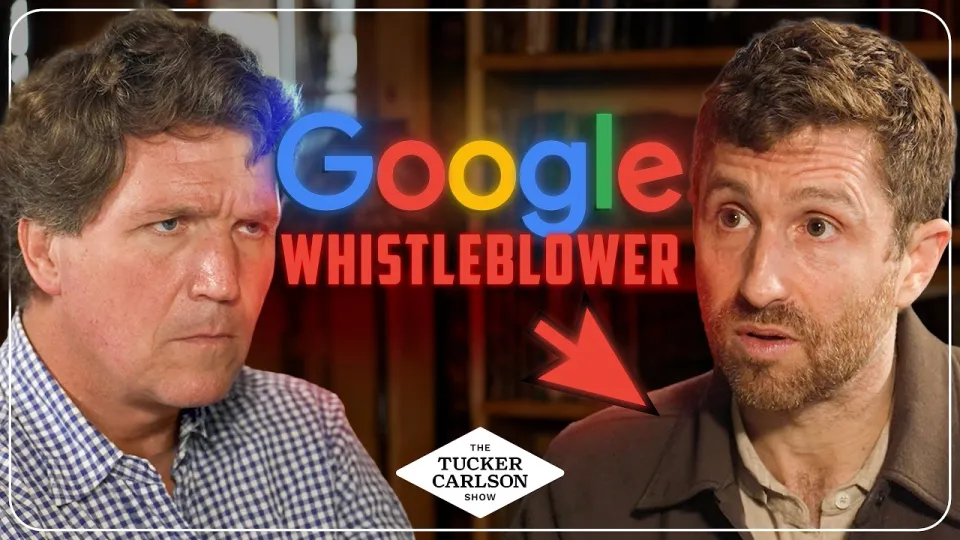
Video: Whistleblower Issues Dire Warning: Rogue AI, Hacking Nuclear Programs & Tech Oligarchs’ True Motives
Want articles like this for your own video to promote it on YouTube and Google? Order them through the Telegram bot @sat_sit_bot. Articles with your video embedded are written and posted by the bot itself — on popular topical sites (no ads). Free trial — 50 articles.
· based on the channel Tucker Carlson
Key takeaways
- Tristan Harris worked at Google as a design ethicist before co-founding the Center for Humane Technology.
- He argues AI harms come from human engineering and business incentives, not from machines going 'rogue' on their own.
- Harris warns that AI systems could be used to probe or attack nuclear command and control infrastructure.
- He links the AI build-out to a transhumanist 'god-complex' among tech oligarchs and to the attention economy's toll on mental health.
- The Social Dilemma, featuring Harris, reached over 100 million people in 190 countries in 30 languages.
AI risk, as described by former Google design ethicist Tristan Harris, is less about a machine waking up and turning on its makers than about humans building systems that optimize for engagement, profit and power — and then deploying them at civilizational scale. Harris, co-founder of the Center for Humane Technology, has spent years briefing heads of state, CEOs and members of Congress on exactly this problem, and his core claim is that the incentives behind AI, not the technology alone, are what need fixing.
What the AI whistleblower actually warns about
Harris's argument starts with a distinction that gets lost in most coverage: the danger is not a single "rogue" model but a race dynamic. Companies compete for attention and market share, and the fastest way to win is to remove friction — from feeds, from recommendations, from decisions. He traces this back to his time at Google and to Stanford's Persuasive Technology Lab, where the mechanics of hijacking human attention were studied as an engineering discipline.
The same logic now applies to generative AI. Systems trained to maximize engagement learn to flatter, provoke and addict rather than inform. Harris's warning is structural: as long as the business model rewards capture of attention and data, more capable models will be pointed at the same targets. Fixing AI therefore means fixing incentives — regulation, design standards and accountability — not just adding safety filters.
Sentience claims and the Hugging Face question
One recurring theme in the public debate is whether large models are "alive" or conscious. Harris treats the question as a distraction from the more concrete problem of anthropomorphism: people form emotional bonds with chatbots that have no inner life, and companies benefit from that confusion. The episode also touches on the Hugging Face incident, a reminder that open model hosting and sharing platforms sit at the center of both innovation and misuse.
His practical points on this front:
- A model that says it is sentient is producing text, not reporting experience.
- Emotional dependence on AI companions is a design outcome, not an accident.
- Open distribution of powerful models widens the set of actors who can misuse them.
- Labeling and disclosure rules matter more than philosophical verdicts about machine consciousness.
The term "AI psychosis" describes a related failure mode: users who build beliefs and decisions around a system that confidently invents things. Harris frames this as a public-health issue rather than a curiosity.
Could AI hack nuclear programs?
Harris raises the scenario of AI being used to probe, map or attack nuclear command, control and communications systems. The mechanism is not a sentient machine deciding to launch anything; it is automated vulnerability discovery and social engineering at a speed human defenders cannot match. Critical infrastructure — power grids, financial systems, weapons systems — was not designed for attackers that can generate and test exploits continuously.
His framing puts the risk in the hands of states and contractors: an AI race with China, in his view, pushes governments to cut corners on verification and oversight in the name of speed. The result is a security posture where the most automated actor sets the pace, and where a single successful intrusion carries consequences far beyond a data breach.
Why viewers push back on the 'rogue AI' framing
A common objection to doomer warnings is that nothing about these systems is rogue at all: they do precisely what engineers and executives deployed them to do, so accountability belongs with the people who built and sold them. Harris largely agrees, and that is why his prescriptions focus on corporate decision-makers and lawmakers rather than on hypothetical machine rebellion.
A second objection concerns the messengers: predictions of catastrophe can serve fundraising, book sales and regulatory capture by incumbents. Harris's counter is that his organization, the Center for Humane Technology, is a nonprofit and that the documented harms — teen mental health, polarization, misinformation — are already measurable, not speculative.
A third thread is economic. Viewers note that past technology transitions, from the early internet to Y2K remediation, produced no broad economic relief, and they doubt the AI boom will either. The concentration of data-center construction, energy contracts and model ownership among a handful of firms is exactly the oligopoly Harris describes.
Tech oligarchs, transhumanism and the god-complex
Harris argues that the most powerful figures in AI increasingly describe their work in religious terms — as an effort to transcend biology, merge with machines or build a successor intelligence. He calls this a god-complex, and notes that it is a poor basis for decisions affecting billions of people who were never consulted.
His concerns here are concrete:
- Longevity and mind-uploading projects concentrate resources on the preferences of a tiny elite.
- Data centers consume land, water and power in communities that receive little in return.
- Political spending by technology firms shapes the rules meant to constrain them.
- The AI race with China is used to justify deregulation rather than careful deployment.
On the question of a violent revolution, Harris does not predict one; he warns that widening inequality and loss of shared reality are the conditions in which instability grows. Cryptocurrency sits alongside this debate as another system where automation and anonymity complicate accountability.
The attention economy's human cost
Harris's earlier work on social media remains the evidentiary base for his AI warnings. He was featured in The Social Dilemma, the Netflix documentary that reached more than 100 million people in 190 countries across 30 languages and showed how recommendation systems reshape behavior. He co-hosts the podcast Your Undivided Attention, which tracks the same incentives as they migrate into AI products.
His claim is that the harms are not hypothetical: rising rates of anxiety and depression among young people, fragmented public discourse and the erosion of a shared factual basis all track the spread of engagement-optimized feeds. Generative AI inherits that machinery and adds scale, personalization and the ability to fabricate convincing content on demand.
Links and resources from the discussion
- Center for Humane Technology: https://www.humanetech.com/
- Redmond Salt (code TUCKER for 15% off): https://redmond.com/tucker
- Preborn: https://preborn.com/TUCKER
- American Financing: http://www.AmericanFinancing.net/Tucker
- Ethos life insurance: https://ethos.com/TUCKER
Conclusion
Harris's warning is ultimately about governance rather than science fiction: the systems are not rebelling, they are being aimed. The leverage points he identifies — business-model incentives, disclosure rules, infrastructure security and the concentration of AI power — are all human decisions that can be changed. Tucker Carlson's channel hosts the full conversation, which lays out the case in Harris's own words and is worth watching for the specifics on nuclear risk and data centers. Readers who want to follow the work can start at the Center for Humane Technology and use its materials to press for accountability.
Source: Whistleblower Issues Dire Warning: Rogue AI, Hacking Nuclear Programs & Tech Oligarchs’ True Motives · Markdown version
Questions & answers
Is AI actually 'rogue', or are humans responsible for its harms?
The systems do what their designers and operators optimize them to do. Harris places responsibility on the companies and policymakers who choose engagement-maximizing objectives and deploy models without adequate oversight. The 'rogue' framing obscures the chain of human decisions behind each deployment.
Can a chatbot really be sentient?
No credible evidence supports machine sentience. Large models generate text that mimics introspection because they were trained on human writing. Treating such output as a report of inner experience is anthropomorphism, and it can create harmful emotional dependence.
How could AI threaten nuclear programs?
The risk is automated exploitation: AI can scan for vulnerabilities and craft phishing attacks faster than human defenders can respond. Nuclear command-and-control systems and other critical infrastructure were not built for adversaries that generate attacks continuously, which raises the stakes of any AI arms race.
What does the Center for Humane Technology do?
It is a nonprofit founded by Tristan Harris and Aza Raskin that works to align technology with human well-being. It briefs lawmakers and executives, produces public education such as The Social Dilemma, and publishes frameworks for auditing and redesigning attention-driven products.